I doubt that Fla76, Blackmore, Gillan and Glover are the main songwriters. While non of us were there, that trio have alway been the mainstay of MKII songs we could say. Jon wasn’t really a rock writer at all was he, much more orchestral etc, his forte indeed. He has no doubt contribute good ideas at times regarding bits and pieces with arrangement in particular, but overall, the other three amigos. We hear 80’s Rainbow mixed with the Gillan band in so many ways on the reunion albums. Well at least I do, that was immediate, not with every song necessarily, but heavily influenced by their experiences with two bands. My take on it anyway. Cheers.
Woah guys, hold your painted horses!
First on my list of key witnesses: Even Roger Glover has said that in hindsight Prudent Strangers - it was more prudent than pedestrian in trying to be perfect, I correct myself - was too safe an album. That doesn’t mean that I don’t rate about half the songs on it and that KAYBD and PS are not great tracks, the former one is one of the most majestic Mk II numbers ever. But one or two swallows a summer do not make, I’m demanding when it comes to DP albums, especially Mk II ones in the wake of their nearly faultless 70s output.
Daniel, I think it’s a little naïve to assume that there is a connection between great art and its maker being what one would describe a wonderful person. That is deification-projection at work. In fact I can think of a lot of examples that indicate the opposite: Richard Wagner, Salvador Dalí, Pablo Picasso, Martin Heidegger, Miles Davis, Chuck Berry, Andy Warhol, Ian Anderson, Roger Waters & Bob Dylan were/are hardly pleasant people most of the time, nasty buggers more like. So Ritchie is in good company. And Mother Teresa wasn’t much of a painter or guitarist, was she?
Or to give an extreme example: Ted Nugent is to me an excellent guitarist with a supple groove, also a good songwriter if he puts his mind to it, but he’s also undeniably a despicable idiot re nearly all other things. To be coherent under your definition I would to either have to say he’s a crap guitarist or a wonderful person. Why should I do that? I have devoured countless books about the Third Reich, yet despise nearly everything it stands for. I don’t look for moral purity in my spheres of interest, everyone knows that the bad guys are more fun to study. I look at everything from all sides and rarely do I find something that is perfect in all aspects. Perfection is unsettling to me. Wenn alles richtig ist, dann stimmt etwas nicht.
But it’s always great to discuss these things with you guys and I rate highly that you sometimes have to hold your breath with me (and sometimes you just don’t, which is ok as well), I never said I was an “easy” DP Family fan. Think of me as the nasty street urchin that yells out “But the Emperor wears no clothes!”
Mac, the songs on Perfect Strangers all come from a secret drawer of Ritchie’s, carefully guarded for a few years… sure, they were arranged by everyone in the legendary Vermont sessions, but in interviews everyone said that Big Ian and Roger had basically only provided the lyrics and 100% of the riffs and melodic structure of the songs were Ritchie’s work, so much so that Lord gave up on any of his ideas because they were of inferior quality.
It’s likely that those ideas were later used in THOBL
At that time the band kept talking about royalties and that Thatcher should do something about it.
I disagree on the “inferior quality” thing even though Jon used the term himself, but then he spent much of his professional career placating either Ritchie or DC. He was a diplomat and avoided what he thought was unnecessary confrontation at almost all costs unless Ritchie really overdid it badly. (As he often enough did.)
That was Ritchie’s biggest fault when he was still a creative force, his inability to also tap on the creativity of others, give them the benefit of doubt and room to breathe. He enriched DP with his ideas immeasurably but he also stifled the creativity of others because he was so particular in what he liked and disliked, very often stopping creative processes in their flow because they simply weren’t his own. In Rainbow, he didn’t realize Tony Carey’s songwriter potential, sheepishly having to call on a commercial fodder songwriter like Russ Ballard instead when he needed a hit. In a 1980 interview he stated that Don Airey couldn’t write songs, but was extremely useful in coming up with ideas for playing Ritchie’s ideas differently . Now who has written more rock songs in the last 20 years or so, Ritchie or Don?
You guys scratch your heads that I have so many criticisms of Ritchie yet still rate his contributions, and I scratch my head that your cherishing of his - undeniable - talents makes you want to gloss over the not so great aspects of his personality. I think we are in actual true fact holding a philosophical debate! 

it’s absolutely philosophy.
of course Ritchie was “the boss” of the band.
Despite some glimpses of Lord as a protagonist in THOBL, despite Dead or Alive building a bridge to Fireball, and despite the fact that the fantastic Mitzie Dupree was mixed with Ritchie’s first and only take because he hated that song, PS has a much higher overall quality and the Man in Black’s solos are varied, they are not recycling of other stuff by him, and reflect a captivating form and a rediscovered creativity on his part, even if only for a short period.
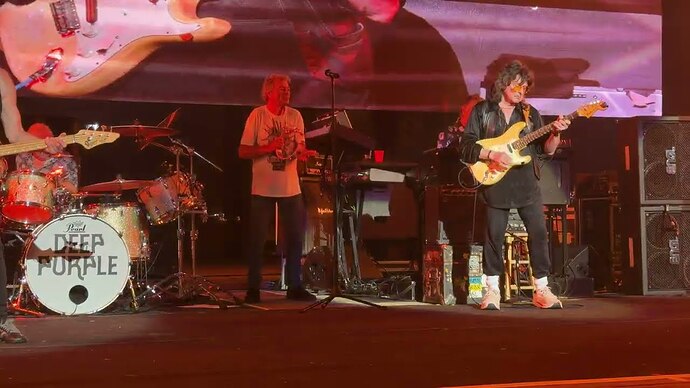


2 Likes
At FaceBook he is quoted to have said that there wasn’t any preparation time for him.
And he also is quoted to say: I came to mend some wounds, but there wasn’t any wound to be mended
That was sweet 
1 Like
Regarding Don Airey as a ‘songwriter’, hmmmmm. Most probably not at the 1980 period with the Down to Earth sessions. He did contribute a little more on Difficult to Cure, more instrumentally though we could surmise. An instrumentalist is Don. He was into co composing on those Cozy Powell ‘solo’ albums, we see his name mentioned on some of the compositions. But as a co vocal ‘song’ writer, not sure about that. Possibly more so these days, being in a permanent band member situation and also in a song orientated band. Difficult to tell though as the songwriting credits are not individually listed. Don moved around a lot more with many heavy rock artists and did a lot of ‘session’ work, much more than Jon Lord ever did back in the day. However he does not have the orchestral works that Jon has. We don’t see Don Airey classical works as in albums or concertos etc, do we. By the sound of it Jon wasn’t into the basis of most of the rock songwriting in Purple. More with some ideas and some arrangements at certain times, by the sound of it from what he has stated. Most probably not a lot else though we could presume. That is where the singer and a bass guitarist who have an inkling of all that and who also work with the guitarist come into the picture. Ritchie had more than an inkling as to vocal songs with melody, but he needs a singer to co write and complete the song. Steve Morse who as we know was and is an instrumentalist first and foremost and who can at times co-create songs with a quality vocalist. Cue Steve Walsh from Kansas and Ian Gillan from Purple. Guitarists who do not sing have to co-write with a vocalist who is into co composing. Blackmore, Page, Iommi, Fripp, Lifeson, Trower etc etc. The guitarists that sing, ala Pete Townshend, Ian Anderson, Paul Simon, Rory Gallagher, even Jimi Hendrix usually turn up with constructed songs and the band then embellishes them. Ken Hensley also was another ‘complete’ writer as such. We don’t see the songs noted as such on later day Purple records, We know why they went back to the ‘band’ songwriting listings, to save on any angst and also to spread the load fairly, so to speak. How involved McBride and Airey are in later day Purple is anyone’s guess due to the songs we hear. Cheers.
1 Like
I think it’s beyond dispute that the harmony and lead parts, as well as their keyboard riffs (or almost all of them) were written by Jon and then by Don.
one thing is the copyright on the supporting structure of a song, and on the words and the melodic line of the words.
another thing is the keyboard and drum parts.
Do you really think that in Purple the guitarist, the singer and the bassist arrive at the recording studio with the keyboard and drum parts to deliver to LittleIan, to Don and even before that to Jon?
Please don’t be fooled by copyright.
This doesn’t mean that the drummer and keyboard player are sitting around waiting for the sheet music from others (and if they were waiting for the PS pentagram from Ritchie, that album probably wouldn’t have been made yet!)
I’m judging Don’s songwriting skills from his half a dozen solo albums which have vocal melodies galore. That was always lurking in him, but he needed someone to lift it. Ritchie has a knack of finding talent initially, but lacks patience to develop people. And he doesn’t want them developing into areas he can’t or doesn’t want to follow. That is where he is stifling. Or was. Maybe it is all different today.
I think that most complex chord progressions do come either from the keyboarder or the guitarist of a rock Band…or they got the likes of a Jaco Pastorius or Jack Bruce playing…i know a drummer who writes Songs but he plays piano too…
Having seen doing his solo on stage half a dozen times i am sure he got deep knowledge of harmonics
I was watching the clip again now after not having seen it for some time. Ritchie himself said it best. That the night was not about the notes played, but something else altogether, which was probably why it was so moving when you saw it for the first time.
Going by the guitar playing alone, when he ended Rainbow almost 30 years ago, he literally must have stowed away his electric guitars too. With the result that he forgot how to play them, his arthritis not helping things. No Engl or AIWA can disguise that RB’s playing today is at 5% of his former capacity, and that’s probably being generous. He did things his own way in that regard too. But as I said, the night was about paying respect to what he created all those years ago.
It’s hard to tell who wrote what when it comes to Purple. Early on, I think and what many say, Blackmore was the driving force, coming up with many riffs. But they also say that they haven’t changed the way they write since '69. It all stems from jams according to themselves. But my gut feeling is that everyone comes in with bits and pieces they want to try out with the band, some stick, some don’t. And in the end, the producer comes in and says- No, we’re doing this!  As they’ve also been upfront with in recent interviews.
So what’s left there in the end is probably a collage of ideas from all of them, and that’s probably why they wanted to stick with the idea of splitting it five ways. Certain members didn’t like that, hence falling out over money etc..
It is a fine line indeed, the splitting of all equal shares in composition or simply noting the main contributors. I can understand an equal share scenario, as in MK II early on and with Black Sabbath during the 1970’s. However I can also get why certain heavy lifters in the songwriting department want or need to clarify who is actual writing the songs etc. As in, the main ideas and that is what actually what gets the record company attention, if the ideas are appealing. So yes, splitting it evenly always keeps the ‘dogs at bay’ so to speak. However the main songwriters wanting to secure their ‘royalties’ etc, I can dig that also. Cheers.
Earlier, when bands were selling records in the millions, it was more of an issue, as the publishing generated a lot of income for songwriters. They still do though if you’re someone like Max Martin.  But a band like Purple won’t get that kind of airplay or similar incomes from publishing, it probably isn’t as touchy a subject today.
About who’s contributing to the songwriting today in Purple - I think Don comes up with a lot of the more ”musical” parts as did Jon Lord earlier, and Simon as well. At least the starting points for songs..just my guess..
In my opinion 90% of the Mark II songs are based on instrumental ideas by Ritchie. Gillan tried to sing something on it and wrote the lyrics with Roger. That’s why there are almost no catchy choruses. “When a Blind Man Cries” might be one of the few exceptions, and “Child In Time” of course. That’s why I don’t believe Gillan’s story of the band that jams together in the studio since 1969.
1 Like
Roger has always said that his songwriting input musicwise was second only to Ritchie’s. And since Roger is biologically incapable of bragging much in the same way as an anteater cannot swallow a water melon whole, I believe him. Speed King and Maybe I’m A Leo are mostly his do.
Ritchie was a riff merchant, the chord harmonies were often an afterthought and DP were never frequent chord changers nor harmonically adventurous. It’s not their style of songwriting, they’re not in that Beatles, Badfinger, 10cc, Cheap Trick or Raspberries school of composition. Most riff oriented bands aren’t (though LZ was a lot more adventurous than DP in that regard).
I think Don Airey’s songwriting contribution today is much greater than Jon’s - within DP that is - ever was, the early Mk I days perhaps excepted.
We also need to consider that in Mk I and Mk II not one musician really came from a songwriting background. Ritchie had been a session and backing musician, Rod and Paicey came from The Maze, a covers band, Lord and Simper from the Flower Pot Men, who only did outside writers’ material, The Artwoods were into improvisation as an RnB outfit, but not into writing songs (which eventually led to their demise) and the Gillan/Glover duo came from Episode Six, yet another covers band.
That is not to say that none of them felt an urge to write, it just means that they had zero experience doing it commercially. And by the late 60s when Purple emerged, it was more or less expected that you would do your own stuff as a “serious-minded” band which Purple on the first two albums of course only did to a very limited extent. That was an aspect where The Beatles had rewritten the playbook or does anyone think that in 1968 or later the Fab Four would have released albums drenched with as many covers as Shades Of and Book of Taliesyn?
The fact that DP were in their homeland not taken seriously until the shift to Mk II has a lot to do with the relatively late emerging songwriting. And frankly speaking, it took them a while to get there, their first album with “real songs” throughout was Machine Head, their sixth (!) studio album. I’d go as far as to say that DP’s unquestionable collective instrumental ability allowed them to be a little lazy in the songwriting department until relatively late in their career, they had the chops to make almost anything sound impressive at first listen and they didn’t have an eye on the singles charts.
2 Likes
After listening to Fireball, Bananas and Splat yesterday in a row i come to the conclusion that Fireball feels like a jam Session with ideas thrown in as they came to the bands mind, Bananas has more pre-written songs and Splat feels like an effort were everyone gave his best…and for the banjo players: i love them all, Simon does not copy Ritchie at all, Steve on the other hand advances lines and melodies that have roots in Ritchie playing solo like in “Fools”
2 Likes
The shorter ‘catchier’ song syndrome, Machine Head. No doubt as we all know their most polished album, for any DP lineup. Most bands start out rawer and take a while to get going, sorting out the writers within the ensemble and also certain musicians etc. Many bands had a few covers and some early ‘rougher’ and naive songs on their early albums. Look at Uriah Heep, Black Sabbath, Yes and even Jethro Tull to name a few. Hindsight reveals that by the time DP got their act together, if that is a way of putting it, hard rock etc, they were already moving on again. These things happen, evolution doesn’t wait. In Rock was crucial as was Fireball, good songs along with the emphasis still on hard rock and extended arrangements, not catchier shorter songs. Thankfully live in concert revealed longer versions of the MH songs at that time. Everyone has to evolve, it is fascinating to look back at so many successful acts and how they all went about it. Cheers.