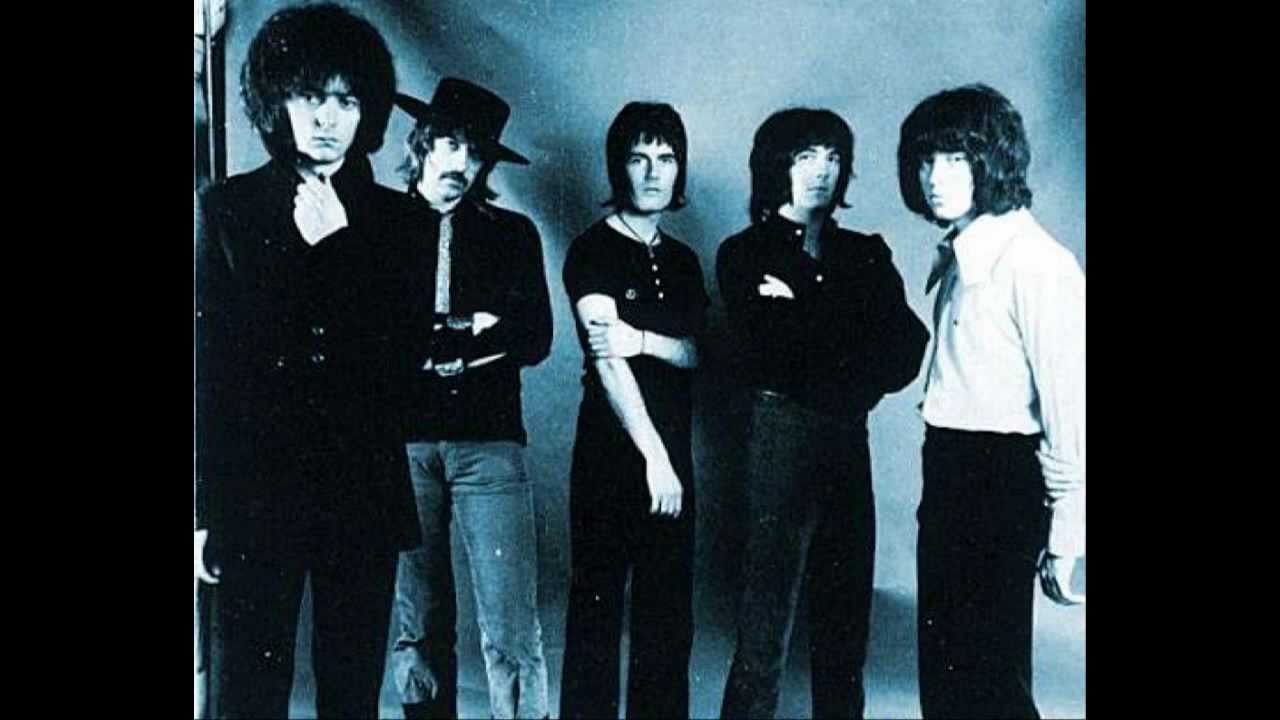
First obvious things first, Nick Simper certainly wasn’t let go because he was not heavy enough as a player. I mean, the first album is fantastic musically, and he has recruited a bunch of people who really know what they are doing. It’s like Spooky Tooth made another real album after Spooky Two (and not the ill-fated Ceremony, which I do occasionally enjoy as one of the scariest recordings ever), but gave it a more Purple outlook.
My only real problem with it is that it would have been ten times better if they had had someone in the band (or even from the outside a la Peter Sinfield or Sandy Pearlman) who could actually write lyrics, too. At best it is pedestrian and at worst it is so badly dated misogynist goo I blush if someone else hears me listening. But the music is so good that in my private space I do my best to ignore it.
IIRC Red Sea was a slight improvement on that level, but musically less interesting. Any hot (or colder) takes?
The Morse Kid knows/digs Warhorse?! He must be a bot then!
Seriously, Zenos, I’m impressed. Not much of a Warhorse fan myself (I dislike the vocals and find the songwriting of stoner rock quality, Red Sea was in parts better than the debut though), more the Captain Beyond guy. That said, the live album of the reunion gig they released not so long ago was better than all their studio efforts combined.
As regards Nick’s bass playing: I’m a bass player myself and he was one of my early influences (together with Roger and Glenn of course), but there was/is something distinctly 60s style in his treatment of the instrument. He never developed a pulse with Little Ian, he more or less played across him while Roger (technically initially not superior to Nick although he advanced rapidly in Purple and left Nick behind soon) meshed and gelled with Paicey from day one. That is why Mk II has a more foundational rhythm section than Mk I.
Nick’s bass playing has charm, but he doesn’t have Roger’s commitment to drive or his steadiness. No way could he have played (or come up with) Roger’s tour de force underpinning (without just playing simplistic root notes) on Highway Star. And he certainly doesn’t have Glenn’s innate feel for stops and starts and yanking the beat around either (neither does Roger whose undeniable strengths as a bassist lie elsewhere).
I like to listen to Nick’s bass playing, but in all its busy-ness (he has simplified his style a great deal since Mk I days) it retains a naïve/pastoral quality. That said, what he played in the bridge part of Kentucky Woman at 01:15
First things first, and I have to admit “being a Morse kid” nowadays means I am well into my 40’s so I have had time to familiarize myself with quite a few groups and albums…
I’m not too deep in the world of bass playing, but I can hear what you mean by labeling Simper a 60’s style player.
The thing is, in terms of music, I am personally torn between whether the best time in music was in the mid-to-late 60’s or early-to-mid 70’s, so I’ll usually just say 1966-1976, which coincidentally covers the entire first Deep Purple run. Captain Beyond’s first album is also one I enjoy, but that seems to be appreciated in much wider circles than Warhorse (maybe one of the reasons is that they had someone who knew how to write lyrics).
Well, they can be either meek/aloof types or devastating alpha males (the latter has the advantage that you don’t feel that bad when doing terrible things to them) and also…
Oh…you meant Deep Purple bass players, right?
Nicky → Macca/60s school of pop playing
Roger → Atomic source of power, simple lines driving the whole band forward
When reading Greg Renoff’s fantastic “Van Halen Rising” book, I was surprised to learn that this LP was a big influence of the VH brothers, particularly the song “Dancing Madly Backwards” which directly influenced tracks like “Outta Love Again” with the chromatic movement on the riffs.
Zenos, you’re still an impressionable young adult in this lair of dinosaur skeletons, so I feel called upon to translate for you what Julio in his Latin-American zest and fervor (these people have uncontrollable emotions!) really meant to say:
Nicky: Definitely pre-Macca school of British bass playing, way too little thirds in his playing to count as a Macca pupil, Johnny Kidd & the Pirates is more like it. Not really locking in with the bass drum, followed Ritchie more in his playing than he followed Little Ian.
Roger: The pulse for Little Ian to build his drum structures on. Melodic, inventive, supple groove, but never striving for attention, yet at the same time at all times “driving the bus”. As technical ability goes, underestimated both by others and himself.
Glenn: Quite the contrary of “all over the place”, Glenn was “a leaver of space” (rhymes!). He never achieved nor strove for Roger’s density of notes (the “throb”) and conventional wisdom is wrong in claiming that Glenn played more than Roger, he played overall less (except when he did his little show-off flurry of notes fills for dramatic effect wich regularly lasted only a few seconds, a lot of that was stage showmanship). Glenn approached bass playing not as a steady flowing carpet, but as a contrapuntal spice to the drums. He was less melodic (again, few thirds) than Roger and sparser, but what he played, he played with extreme A-T-T-I-T-U-D-E, that is what makes Glenn’s bass playing stand out, not technical superiority vis-à-vis Roger or amount of notes. Glenn had a bass player’s unusual stance of demanding to be heard and making a difference (though, ironically, on the studio recordings of DP at least, Roger’s bass playing came across as more prominent, especially during his Rickenbacker phase). He also had a sense of drama in his playing (which likely attracted Ritchie) that escapes Roger’s nature. Glenn was once asked what he thought his greatest contribution to DP was and he answered after a moment: Changing Paicey’s approach to drumming. I tend to agree with that, as Glenn did not supply the “Roger carpet” to Little Ian, he made him think outside of the box and become progressively more funky himself.
To return to the topic I took up listening to Red Sea again, and while at first I thought I had judged it too harshly, after the first couple of songs it all came back to me. Where Warhorse is a competent 1970 album (when one ignores the lyrics), Red Sea, recorded 1972, sounds more like it’s from 1968. Also, the lyrics also get progressively worse. Feeling better having written the letter? Coming up with words that rhyme with Sibylla? Warhorse got you covered. And then there’s the late-60’s main offender: a drum solo recorded in a studio. And we’re not talking about The Mule or even Moby Dick here, but something that would have been mildly interesting five years before and, by 1972, a trite rehash to fill the album.
Anyway, there’s promise present, and when there’s at last an actual song by actual songwriters included - I (Who Have Nothing) - it sounds marvellous and makes me wish they had gone full Vanilla Fudge.
Red Sea suffered from budget cuts out of the blue and running out of time in the studio. Plus Peter Parks hadn’t found his footing as a songwriter yet. Where it’s good I still think it’s marginally better than the debut.
But really: Warhorse is to DP for me like Blue Cheer is to Cream: Similar at first glance, but in reality eons behind in musical development and sophistication. Warhorse’s music is to me so clumsy and lead-footed, I don’t even get to the - likewise awful - lyrics. If DP is A league, Uriah Heep B league and a band like Budgie C league, the Warhorse guys are comfortably between D and E league for me.
I can agree with your assessment about Warhorse, even if I do often enjoy the kind of “lead-footedness” as well. As for Blue Cheer, I can accept the general sentiment, and it is true that they definitely became a joke (I have listened to Dining With The Sharks through and won’t be repeating that experience anytime soon).
But I will say that Vincebus Eruptum is a great album, one of the very best of 1968 (and it is a competitive year).
Yeah, Vincebus Eruptum at least had a nasty edge, Warhorse was just staid and pretentious when there was little to pretend! I thought the two guitarists - Peck and Parks - were actually still the most redeeming thing about them.
But then I’m overall more the Fandango guy, they were at least tuneful and had a good singer:
Overall, JLT’s Fandango are of course more accomplished and better songwriters than Nick’s outfit of the same name, but the UK Fandango had their moments with their slightly pedestrian version of an early Foreigner sound. I like Peter Parks’ terse and percussive guitar style, he’s not really a hard rock, much less a heavy metal player.
The two albums of Nick Simper’s Fandango are well worth having, even the somewhat budget/demo’ish production has its charm. They are also a good study of how Nick plays bass post-Mk I & Warhorse.



 ?
?